Should I buy on Lake Austin or Lake Travis?
Choose Lake Austin if you want water held near a constant level and a short drive into the city, and Lake Travis if you want big open water, more marinas and more choice of lot size, and you can live with a lake level that rises and falls. On price, Lake Austin waterfront ran $1,002 per square foot on the Keenan Luxury Market Index over the trailing 24 months through Q2 2026.
Both lakes are part of the Highland Lakes chain on the Colorado River, and they sit next to each other: Lake Travis is held back by Mansfield Dam, and Lake Austin runs from just below Mansfield Dam down to Tom Miller Dam in west Austin. That shared river is about all they have in common as places to live. The level of the water, who writes the dock rules, how people use the lake and how long the drive is to downtown all differ, and those are the things that decide which one fits.
Keenan Group has represented buyers and sellers on both lakes over 25+ years and 1,000+ homes sold. This comparison covers what changes day to day and what to verify before you buy.
How do the two lakes compare side by side?

| Lake Austin | Lake Travis | |
|---|---|---|
| Water level | Kept near a constant operating level; it is a pass-through lake and can still fluctuate, especially during floods | Rises and falls with drought and floods; record low 614.18 ft (Aug. 14, 1951), record high 710.44 ft (Dec. 25, 1991) |
| Role in the river system | Pass-through lake below Mansfield Dam | Main flood-control and water-storage reservoir of the Highland Lakes |
| Size | Long, narrow, river-like | About 65 miles long with about 270 miles of shoreline |
| Dam operator | Tom Miller Dam is owned by the City of Austin and operated by LCRA | Mansfield Dam is operated by LCRA |
| Who regulates residential docks | City of Austin | Docks must meet LCRA dock safety standards; cities such as Lakeway and HOAs may add rules |
| Boating rules | City of Austin code, enforced by Austin Police Lake Patrol | LCRA, Travis County and the local city or HOA |
| School districts (verify by address) | Eanes, Austin and Leander ISDs | Lake Travis, Leander and Lago Vista ISDs, plus others farther upstream |
| Price per square foot (KLMI, trailing 24 months, Q2 2026) | $1,002 | Not tracked as one market in the KLMI; varies widely by shore and community |
Water level, dock rules and school assignments are where buyers most often make assumptions, so each has its own section below.
How do the water levels differ?
This is the biggest practical difference between the two lakes.
The City of Austin describes Lake Austin as a pass-through lake that does not have extra capacity to store floodwaters and is maintained at a constant water level. Water released from Lake Travis upstream keeps it full. Pass-through lakes like Lake Austin are kept within a small range but can still fluctuate, especially during floods. The largest planned drops come from drawdowns the City and LCRA schedule, usually to control hydrilla and let owners repair docks and shoreline. The City canceled the drawdown that had been scheduled for October 12 through November 30, 2026, and says there will be no planned drawdown of Lake Austin in 2026.
Lake Travis is the region's primary flood-control reservoir and has the largest storage capacity of the Highland Lakes, so its level moves with the weather. Its recorded range runs from 614.18 feet on August 14, 1951, to 710.44 feet on December 25, 1991, a difference of about 96 feet. As of October 4, 2026, Water Data for Texas showed Lake Travis at 94.3% full. When the lake is low, some docks sit on dry ground and some coves become hard to reach; when it is high, docks and shoreline can flood.
For a Lake Travis home, ask how the dock and shoreline behave across that range: where the water is at a typical summer low, whether the dock floats or is fixed, and whether the cove holds enough depth for your boat in a dry year. On Lake Austin, the question is simpler: how the dock and shoreline hold up during a planned drawdown, when one is scheduled.
Who regulates docks and the shoreline?
On Lake Austin, the City of Austin manages dock permitting and safety rules, and dock permit questions go to Austin Development Services. Boating, swimming and other on-water rules come from the City code and are enforced by the Austin Police Department's Lake Patrol.
On Lake Travis, residential docks must meet LCRA's dock safety standards. Cities such as Lakeway, and many homeowners associations, add their own requirements for size, design and placement. In some resort and gated communities, owners use a community marina instead of a private dock.
On either lake, ask for the dock's permit history, any recorded easements and the HOA's dock rules before you write an offer. A dock that was built without the right approval, or that sits partly on someone else's frontage, is expensive to fix after closing.
How do people use each lake?
Lake Austin
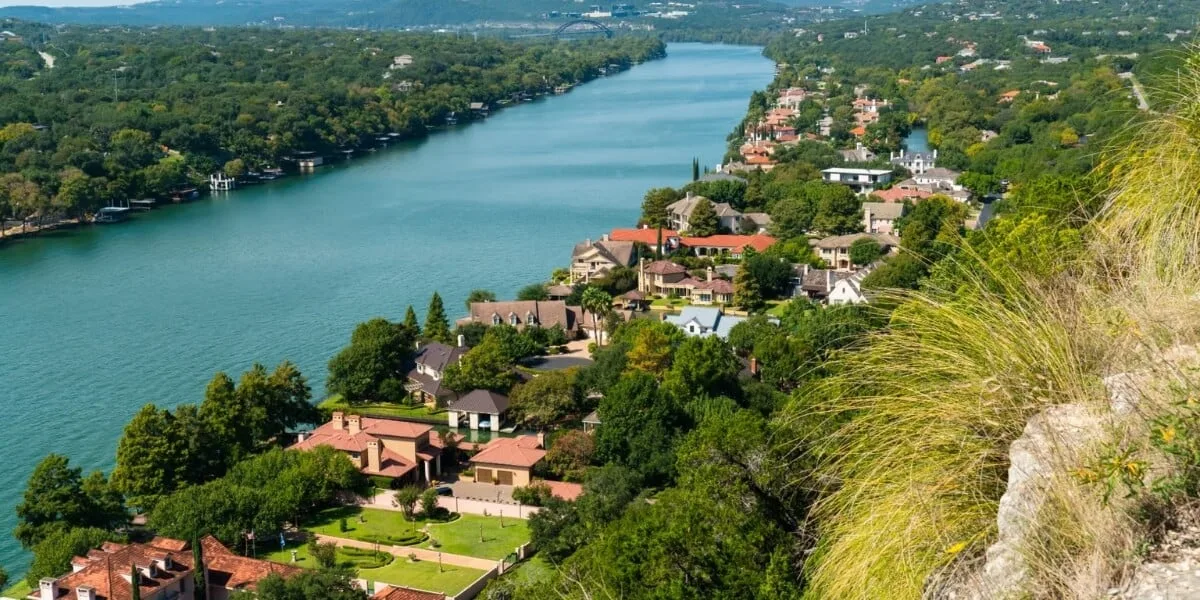
Lake Austin is narrow and lined with homes, so it feels like a river through the city. You will see evening cruises, paddleboards and kayaks, and a lot of water skiing, wakeboarding and wake surfing; the City's stakeholder notes on lake management list wake surfing and wakeboarding safety among residents' concerns. Most owners keep boats at a private dock or on a lift, and because the City sets the boating rules, the same rules apply along the whole lake.
Lake Travis
Lake Travis is open water with long reaches, coves and islands that appear at lower levels. It suits longer runs, larger boats and days anchored in a cove. There are more marinas and boat-service businesses around Lake Travis, with wet slips and dry storage, which matters if you would rather not maintain a private dock or if your lot's shoreline changes with the lake level.
Crowds and quiet
Both lakes get busy on summer weekends and holidays. On Lake Austin, the traffic is spread along a narrow channel past homes. On Lake Travis, it tends to gather in popular coves and near marinas, while the shoreline away from those spots can be quiet for much of the week.
How far is each lake from downtown?
Lake Austin waterfront is on the city's west side, so homes in 78746 near Westlake Hills and along the west Austin shoreline are close to downtown, often by way of MoPac or Loop 360. Lake Travis communities such as Lakeway, Hudson Bend and the shoreline near Bee Cave and Lago Vista are farther out, and the drive depends on RM 620, Bee Cave Road and FM 1431, which all slow down at peak hours.
Commute times change with the exact address and the time of day, so drive your real route at the hour you would travel before deciding. For many Lake Austin buyers the short drive is the reason they choose it; Lake Travis buyers usually trade a longer drive for more water and more land.
What are the neighborhoods and homes like?
Lake Austin
Lake Austin homes range from older houses on smaller close-in lots to large estates on bluffs, with established trees and a mix of renovated, rebuilt and original homes. Supply is limited by the length of the shoreline, which is part of why per-foot prices run high. Austin Country Club sits on Lake Austin, and its membership is private and separate from owning a home nearby.
Lake Travis
Around Lake Travis you will find resort-style gated communities, master-planned neighborhoods and standalone homes on larger lots, some with golf, club amenities and community marinas. Lot sizes vary more than on Lake Austin, so it is easier to find acreage with water access, and some communities are set up for second homes as much as full-time living.
What should I know about schools?
School assignments around both lakes depend on the address, and both lakes cross district lines. Lake Austin waterfront falls in Eanes ISD, Austin ISD or Leander ISD depending on the stretch of shoreline. Lake Travis waterfront falls mostly in Lake Travis ISD, with parts in Leander ISD and Lago Vista ISD and other districts farther upstream. Check the district's attendance tool for the specific address and review its current accountability report.
Are short-term rentals allowed?
Rules depend on the city or county the home is in, and HOA rules apply on top. Lake Austin homes inside Austin city limits fall under the City of Austin's short-term rental licensing rules. On Lake Travis, rules depend on whether the home is inside a city such as Lakeway, which sets its own permit rules, or in an unincorporated area, where HOA and deed restrictions are often the main limits. If rental income matters to your plan, read the current city ordinance and the HOA documents before you make an offer.
What should I budget for on the water?
Waterfront homes carry costs that inland homes do not. Plan for dock and lift maintenance, shoreline repair, possible higher insurance premiums and flood insurance where the elevation and flood zone call for it. In resort and gated communities, add marina fees, amenity assessments and HOA dues. On Lake Travis, a floating dock and its anchoring need attention as the level changes; on Lake Austin, the planned drawdowns are the usual window for repairs.
How do the two markets compare on price and resale?
Lake Austin waterfront ran $1,002 per square foot over the trailing 24 months through Q2 2026 on the Keenan Luxury Market Index. Its limited shoreline, short drive to the city and steady water level all support that number. Lake Travis covers a wider range, from more accessible homes on smaller lots to large estates, and prices vary sharply by cove, water depth and community, so it is not tracked as a single market in the index.
On either lake, resale depends on how well a home delivers what waterfront buyers pay for: a usable dock, deep enough water, a good view, and on Lake Travis, a shoreline that works across the range of lake levels. We compare closed waterfront sales on the same stretch of shoreline before recommending a price.
Which lake fits your goals?
Choose Lake Austin if you want a water level held near constant, a short drive into the city, a private dock and a residential setting along a narrow, busy-but-local lake.
Choose Lake Travis if you want open water and long runs, more marinas, a wider choice of lot sizes and price points, and you are comfortable planning around a lake level that changes.
Buyer checklist
- Dock permit history, recorded easements and the HOA's dock rules.
- On Lake Travis: how the dock and cove work at a typical low and in a dry year.
- On Lake Austin: the City's current drawdown schedule and how the dock handles one.
- Commute time on your real route at peak hours.
- School district and campus assignments for the exact address.
- Short-term rental rules from the city and the HOA, if rental income matters.
- Flood zone, elevation and insurance quotes.
- Utilities on site, including city sewer or septic.
- Marina and boat-service options nearby.
How do I evaluate a specific property?
- Confirm the dock. Ask for permits, plans and any changes made for low water.
- Read the rules. Request HOA guidelines, community marina policies and the city's shoreline rules.
- Check utilities. Find out whether the home is on city sewer or septic and what that means for future work.
- Assess risk. Review elevation, flood mapping and the shoreline's maintenance history.
- Test the commute. Drive your normal route at your normal time.
- Verify schools. Confirm address-level assignments with the district.
- Line up services. Find the marinas, service providers and storage that fit how you boat.
When you are ready to compare specific homes or coves, contact the Keenan Group. We can pull closed waterfront sales on the stretch of shoreline you are considering and help you request the dock and HOA documents.
FAQ
How do water levels differ between the lakes?
Is a Lake Austin drawdown planned for 2026?
Which lake is better for large boats and long runs?
What commute should I expect from each lake?
How do school districts compare around the lakes?
Who regulates docks on each lake?
Are short-term rentals allowed on both lakes?
How full is Lake Travis right now?
Is Lake Austin or Lake Travis more expensive per square foot?
Lake Austin waterfront carries the higher per-foot figure: $1,002 per square foot on the Keenan Luxury Market Index over the trailing 24 months through Q2 2026. Limited shoreline, a short drive to the city and a steady water level all support it. Lake Travis varies widely by cove and community.
Which lake has a shorter commute to downtown Austin?
Lake Austin. Its waterfront is on the city's west side, near MoPac and Loop 360. Lake Travis communities such as Lakeway and Hudson Bend are farther out and rely on RM 620, Bee Cave Road and FM 1431.
Which lake is better for big-water boating, Lake Austin or Lake Travis?
Lake Travis. It is a large reservoir with open water, coves and more full-service marinas, suited to longer runs and larger boats. Lake Austin is narrow and river-like, popular for cruising, skiing and wake sports close to town.
More Austin Neighborhood Comparisons
- Tarrytown vs Westlake Hills - Central Austin walkability vs the hills
- Tarrytown or Bryker Woods? - The 78703 comparison
- Rollingwood or Westlake Hills? - Two small 78746 cities compared
- Austin Waterfront Homes Guide - Lake Austin and Lake Travis inventory
- Lake Austin neighborhood guide - The pass-through lake on Austin's west side
- Lakeway neighborhood guide - A Lake Travis city with golf and a marina
- Lake Travis ISD guide - The main district around Lake Travis
- Austin Private Clubs Guide - Austin Country Club on Lake Austin and clubs around Lake Travis
Ready to take the next step? Get a home valuation if you are considering selling, explore buyer resources if you are searching, or review the Keenan Group's track record across 1,000+ Austin homes sold.
Interested in Tarrytown?
Get a confidential market brief for Tarrytown with current inventory, pricing, and strategy recommendations from Austin's #1 team.